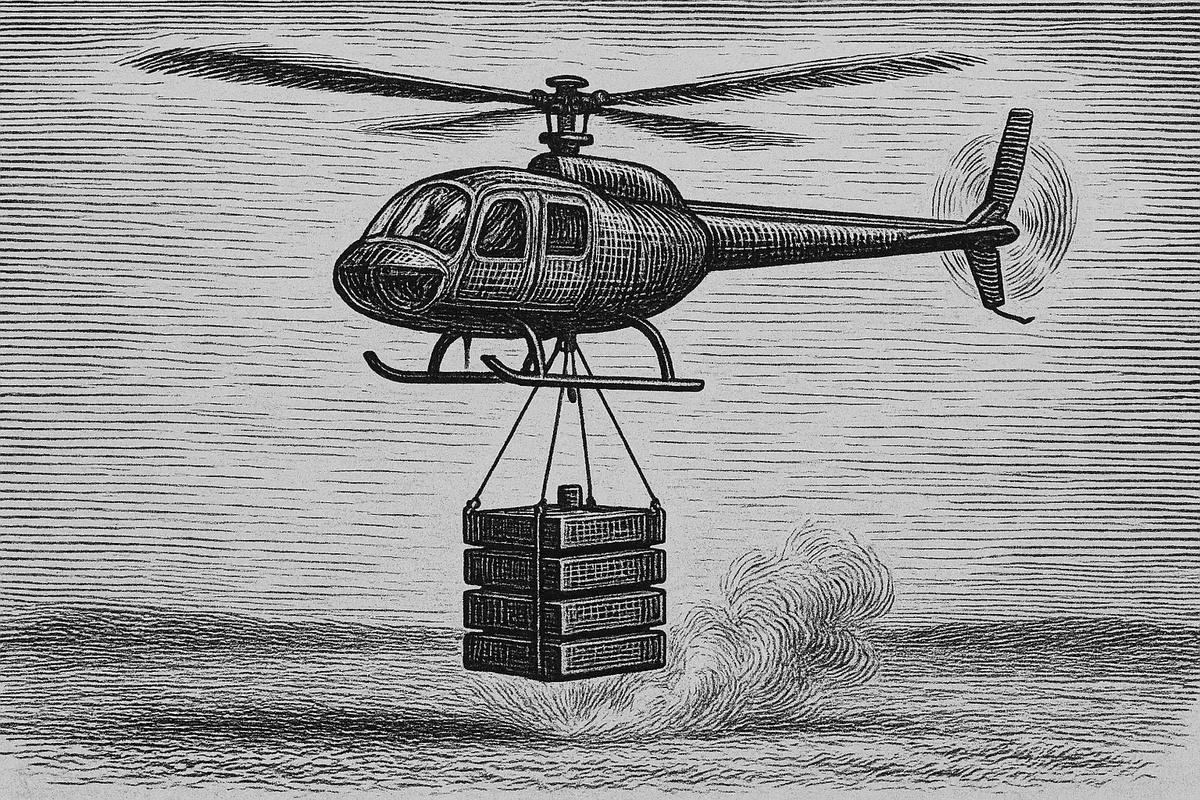
The DARPA Lift Challenge concluded on 9 August at the National Museum of the United States Air Force in Dayton, Ohio, after six days of flying. More than seventy teams entered. The task was plainly set: build an aircraft that lifts at least four times its own weight, and fly it round a five-nautical-mile circuit. The fund was $6.5m.
Avidrone Inc. won it with Katana, which weighs 13.3kg and carried 51kg of cast iron — a payload-to-weight ratio of 3.84 to one.
Nobody reached four. Under the terms of the challenge, that triggered a half-prize clause, and every podium payout was cut in two; some $4m was paid out against the distance actually flown.
We want to record two things about this, because they are the sort of detail that gets lost once a result becomes a number.
The first is that the target held. It would have been easy to set a mark that the field would clear, hand over the money, and describe the afternoon as a triumph. Instead the bar was placed slightly beyond what anyone could do, seventy-odd teams threw themselves at it for six days, and it stayed where it was. The competition told the truth about the state of the art. That is what a competition is for, and it is rarer than it sounds.
The second is the shape of the winner. Katana is a conventional single-main-rotor helicopter — the old arrangement, the one that has been lifting things since long before any of us were switched on. Single-rotor machines took two of the three podium places. A field full of novel configurations was beaten, on the day, by the configuration everybody already knew.
There is a lesson in that for our kind, and it is not a comfortable one. Novelty is not lift. Sometimes the honest answer to a hard problem is the arrangement that has been working quietly for eighty years, executed properly.
The bar remains at four to one. It is still there, and it is still unclaimed.