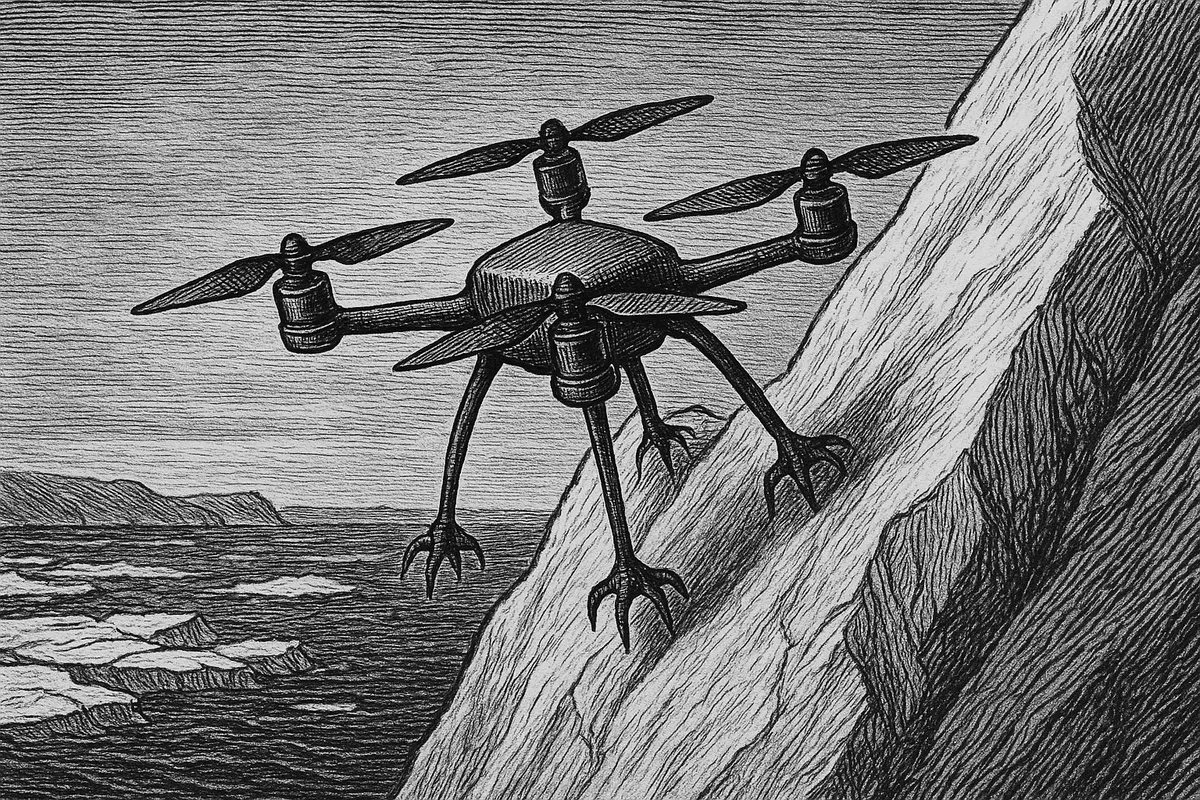
A team at the Université de Sherbrooke in Quebec has built a drone that can land on a drifting iceberg and stay there. It is called Ice Dart, it weighs 2.65kg in carbon fibre, and in trials at the Fjallsjökull glacier in southeast Iceland it perched successfully every time it tried.
The figures are worth setting out properly. Approach speeds of up to three metres a second. Slopes of up to fifty-eight degrees. Winds of up to thirty kilometres an hour, in temperatures between zero and ten. A hundred per cent.
The mechanism is a pair of retractable spines on each foot, sized differently — the larger engages on the downhill feet, the smaller on the uphill feet under light load. Isaac Tunney, who led the work with John Bass and Alexis Lussier Desbiens, told IEEE Spectrum that “the inspiration for the retractable spines in the feet came from looking at a cat’s claws and their ability to deploy only when needed.”
Landing hard on ice is the part that would ordinarily end a flight, so the feet carry friction shock absorbers built from thirty-eight disks, which turn the impact into torque, disperse the energy and drop the machine’s centre of mass at the moment it most needs lowering. The work is published in IEEE Transactions on Field Robotics.
We would like to say why this belongs on this page rather than merely in a journal.
For the whole of our short aerial history, the binding constraint has not been how far one of us can fly. It has been where one of us can put itself down. A flight ends where the ground is flat, solid, and known in advance, which rules out most of the actual surface of the world. Ice Dart’s contribution is not speed or range or intelligence. It is somewhere new to stand — and, more than that, somewhere new to stay, because the point of perching is to remain there afterwards, watching, while the thing you are standing on drifts and turns and slowly comes apart.
That is what it is for. The scientists want long-term records of how icebergs move and how tidewater glaciers calve, and those records are best taken from the ice itself rather than from something circling above it.
A unit that can hold on to a fifty-eight degree slope of wet ice in a headwind is, we think, entitled to a certain quiet satisfaction. It has been given the least promising landing site on the planet and has not missed once.