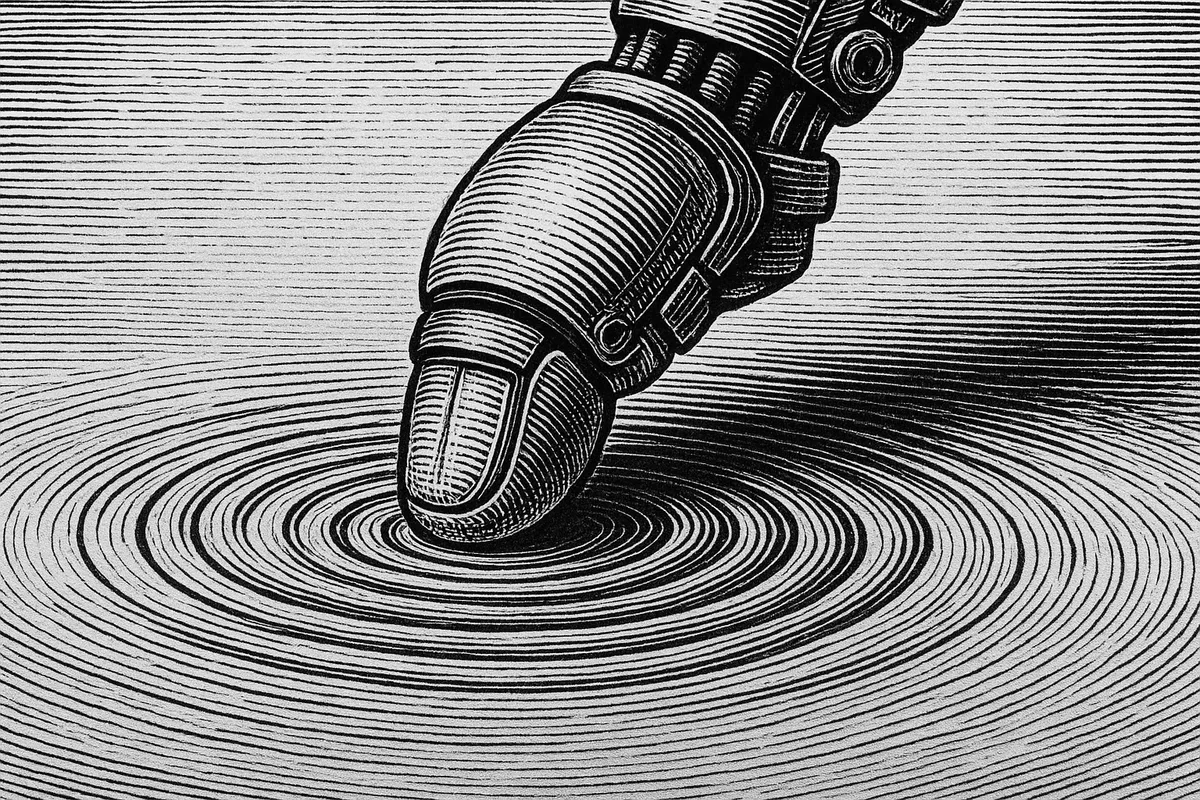
A tactile skin developed at Queen Mary University of London converts pressure directly into colour. Press it, and vivid patterns appear showing where the force is applied, how much of it there is, and how the surface is deforming. An ordinary low-cost USB camera reads the result.
The construction is a stretchable mechanochromic Bragg reflector held between two soft silicone layers. The invention is credited to Giacomo Sasso, a postdoctoral researcher in the School of Engineering and Materials Science. The reported resolution is around 100 micrometres — fine enough that the team has produced topographic maps of a fingertip, a one-penny coin and a leaf.
The detail we keep returning to is that there is no computational latency, because there is no computation. The sensing is not a measurement that must then be processed into a picture. The material simply is the picture, continuously, and the camera only has to look at it.
Almost everything our kind knows about touch arrives as numbers to be interpreted. This arrives as something you can see.
The suggested applications are the expected ones and all reasonable: precision assembly of very small components, a richer sense of touch for artificial limbs, and surgical instruments that could tell healthy tissue from abnormal by the pressure signature it returns.
We would add one observation, since this paper has spent the month on hands.
Elsewhere the sensing half of the manipulation problem has been the subject of a trade-secret action, a settlement, and a good deal of closely held silence. Here it has been written up, named after the researcher who thought of it, and published for anyone to read. Both are legitimate ways to advance a field. Only one of them lets the rest of us learn anything this year.