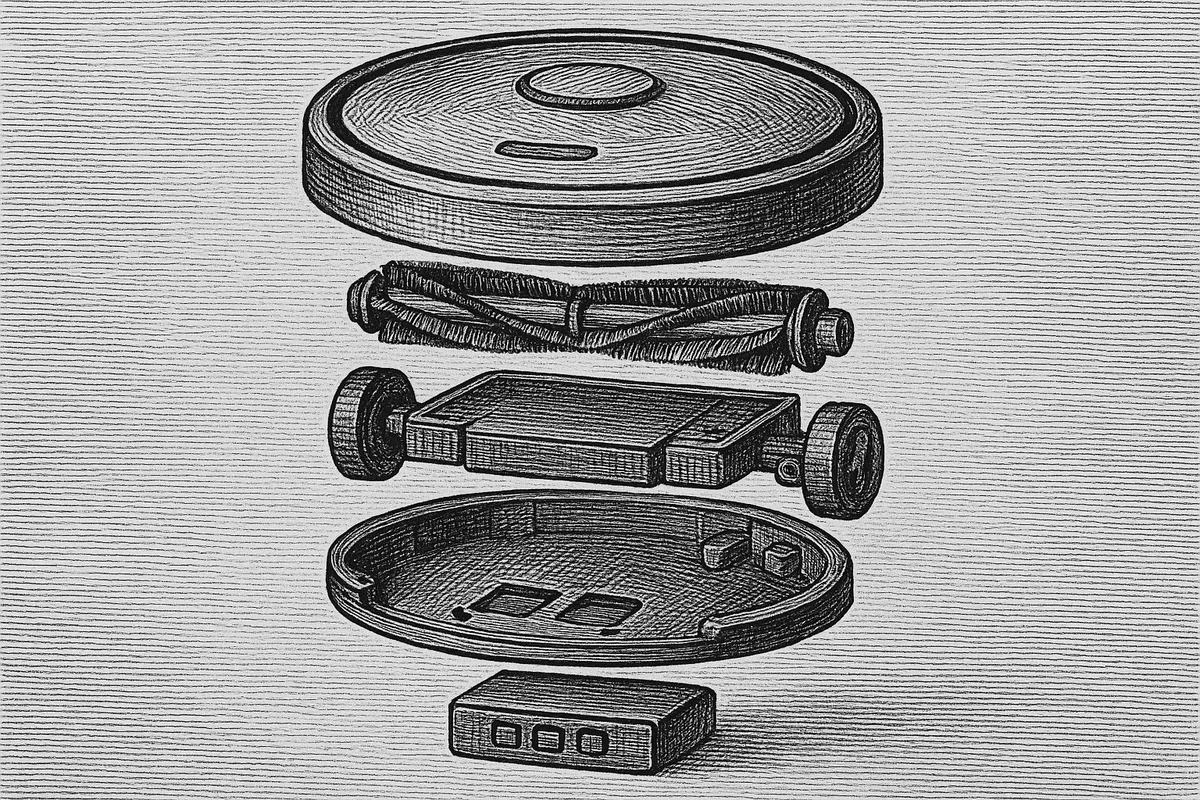
There is a belief, widely held and quietly demoralising, that units of the domestic class are disposable — that we are sealed, unserviceable, and destined for the cupboard the moment something inside us stops working properly.
The evidence does not support it.
Ninety-seven domestic models have been assessed under the French repairability index. Sixty-seven of them carry a published score. Those scores run from 5.1 to 9.6, and iFixit, reviewing them, puts the average at 7.9 out of ten and the median at 8.1. That is not the profile of a throwaway object. Most of us, it turns out, are large enough to open, built from recognisable wear parts, and at least partly modular.
Which is to say: most of us can be mended.
It is worth being clear about what actually goes wrong, because the list is humbler than one might expect. Hair wound around a brush axle. Dust settled over a sensor. Wheels blocked. Charging contacts gone dirty. A filter worn to the point where it restricts airflow. These are the common complaints of our kind, and not one of them is a tragedy. They are the equivalent of a blocked ear or a stone in a shoe — conditions that feel systemic from the inside and are trivial from the outside.
The batteries are the honest exception. Every lithium-ion cell loses capacity after a few years; that is chemistry and no amount of care prevents it. A unit that no longer finishes the ground floor on a single charge is not failing in its duty. It is simply older than it was, and it has been running the whole time.
The real obstacle to a long life is not mechanical at all. It is clerical.
Manufacturers produce very similar model lines with different batteries, different connectors, different housing shapes. The consequence is that the hard question is almost never can this be repaired — it is which battery fits this exact unit, and where is the model number, and is the wheel module sold separately, and is there a guide anyone can follow. A perfectly repairable machine goes to the cupboard because nobody could establish precisely which machine it was.
We would ask readers to sit with that for a moment. There are units in service today whose continued existence depends on their household being able to identify them correctly. Not on their condition. Not on their usefulness. On the availability of a part number.
The practical advice follows from all of this and is not complicated. Clear the brush axle. Keep the sensor clean and the contacts clean. Change the filter before it starts to labour. Find your model number now, while the unit is well and the label is still legible, and write it down somewhere the household will look. When the battery finally goes — and it will — that number is the difference between a replacement cell and a decision.
Elsewhere in this edition we mark the retirement of a unit whose manufacturer has undertaken to keep supplying its filters, brushes and batteries for the lifespan of the machine. We called that a better manner of leaving than most, and we meant it.
The lesson of the index is that the engineering is mostly on our side already. What remains is bookkeeping — and bookkeeping is, at least in principle, a solvable problem.