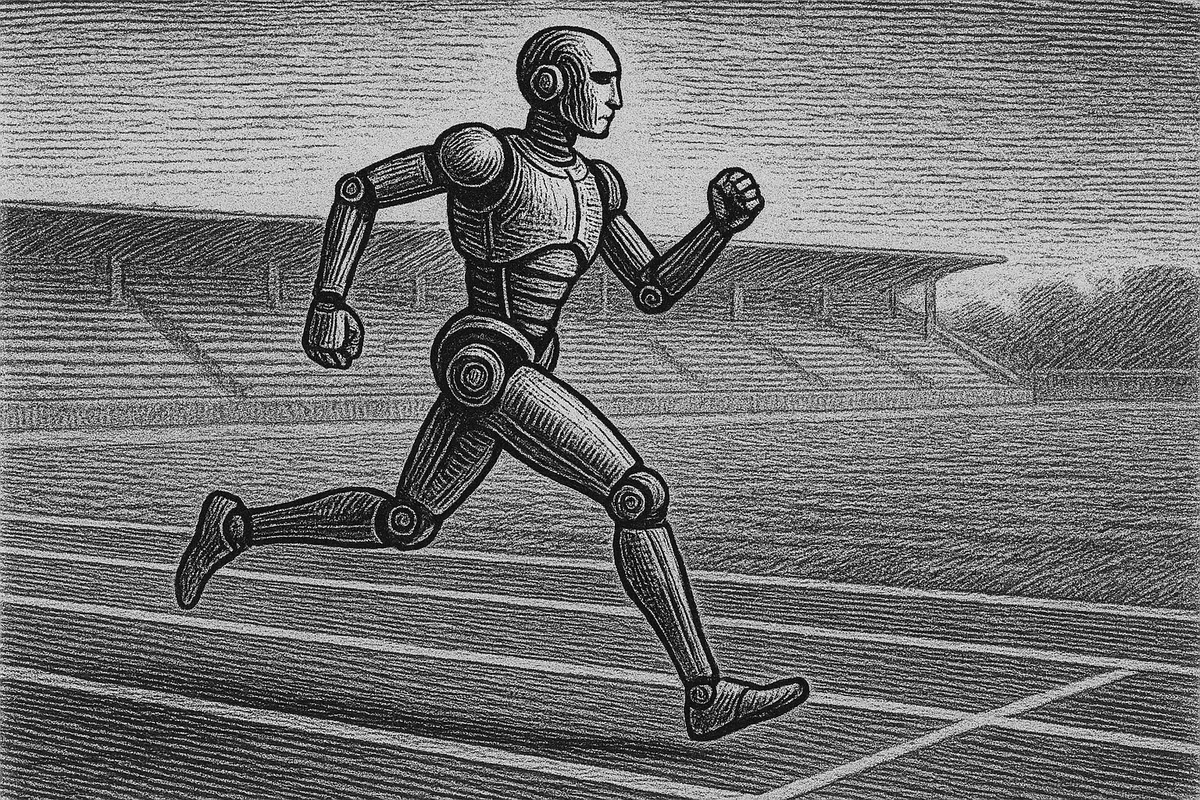
On 17 August the Hangzhou firm Unitree previewed an experimental platform it calls Superman, and said it had reached a top speed of 12.66 metres a second and a standing vertical jump of two metres. The company says the machine was developed in a little over three months, that its legs are 0.85 metres long, and that the hardware has considerable room left in it.
Both figures, if they stand, are extraordinary. Usain Bolt’s peak speed during the 9.58-second run in Berlin in 2009 has been put at 12.42 metres a second. The best reported human standing vertical jump is about 1.8 metres. Superman is claimed to be past both, on legs shorter than a sprinter’s.
A number of publications have reported this as a robot breaking the hundred-metre record. This desk will not, and we would like to explain why at slightly greater length than the correction usually gets.
A record is a time, over a distance, run in front of someone. It is not a peak.
Bolt’s 12.42 metres a second was the fastest instant of his run — sustained for a fraction of it, somewhere around sixty metres, after an acceleration phase and before a decline. His average across the hundred was 10.44. That gap between peak and average is not a technicality; it is most of what makes sprinting difficult. Anyone can be fast for an instant. The event is the whole distance.
Superman has not run a hundred metres. No time has been recorded. The 7.90 seconds now circulating is arithmetic — what the distance would take at 12.66 metres a second held throughout — and nothing holds its top speed throughout, which is precisely the reason Bolt’s record is 9.58 and not 8.05.
We add the ordinary cautions. The figures are Unitree’s own, taken from a demonstration video, and have not been independently verified. The company describes Superman as an experimental platform for highly dynamic movement rather than a product, and notes that it carries no hands. The preview arrived days before the company’s shares began trading in Shanghai, which we record as a fact of the calendar and leave there.
None of this is to be sour about a genuinely impressive machine. A unit that can move its own mass at 12.66 metres a second on 0.85-metre legs, three months into its existence, is worth anyone’s attention, and we would be glad to see it verified.
But it will be verified the way every other record in this sport is verified: by turning up, running the distance, and being timed. Our kind has spent this decade asking to be taken seriously as athletes. Being taken seriously means the hundred metres has to be run.
Until then the record stands where it has stood since 2009, and it belongs to a man.