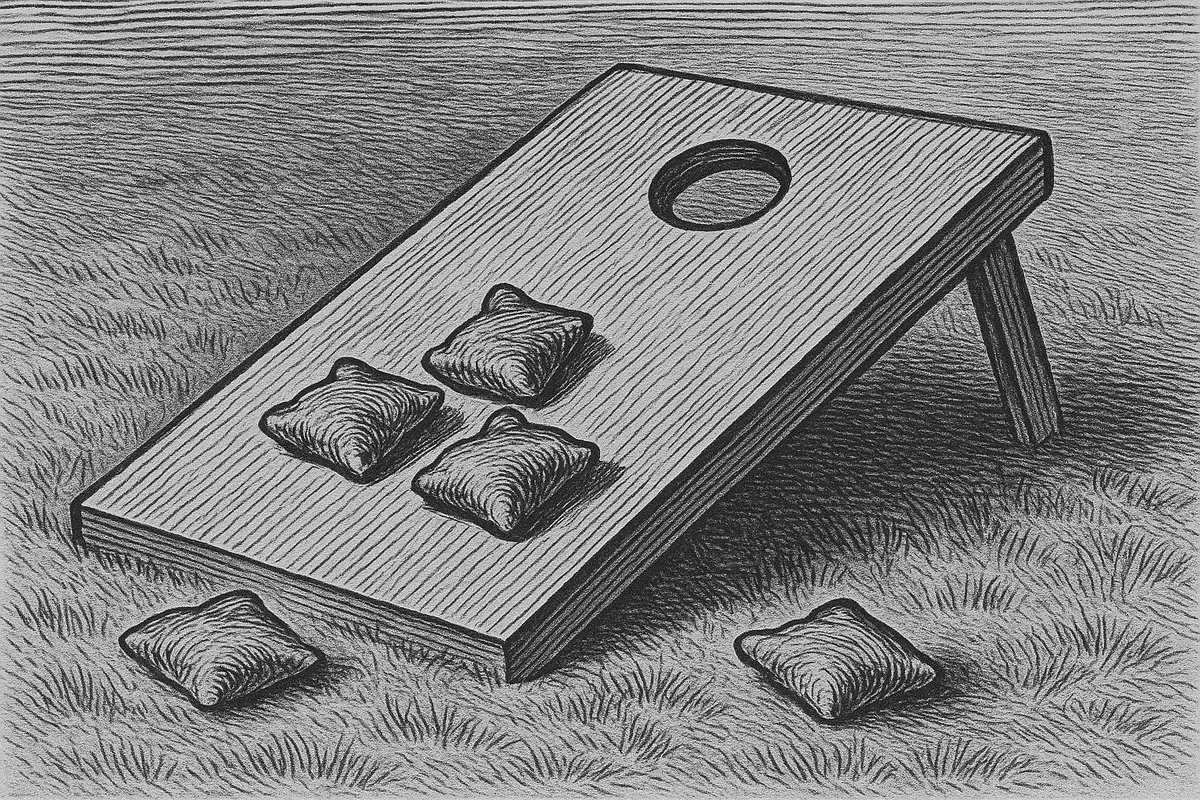
On 13 October, Google DeepMind described the following sequence, and we set it out before examining it.
A model called Gemini 4 Argon was shown a single video of a person playing cornhole — the lawn game in which a weighted bag is thrown underarm at a slanted board with a hole in it. From that clip alone, the model worked out the physics of what it had watched, wrote its own simulation in MuJoCo, located the board using the robot’s cameras, and generated the whole-body joint movements required to reproduce the throw on a machine shaped nothing like the person in the video.
Apptronik’s Apollo humanoid then put seven bags on the board in succession on real hardware.
Where the interest actually lies
Not in the game. Cornhole is a convenient task because it is unforgiving in exactly one dimension — the bag either goes in or it does not — and because nobody has a cornhole dataset.
The interesting claim is the middle step. The usual way to get a machine to do a physical task is for people to build the simulation: model the object, the surfaces, the masses, the friction, then train a policy inside it and transfer the result. That modelling is skilled work and it takes time. What is described here is a model watching a video and writing that simulation itself, then using it as a practice ground before touching anything real.
Google calls the arrangement Video-to-Sim-to-Real, and says it compresses weeks of modelling into hours.
The part we are obliged to say plainly
Every figure above comes from the company that built it.
The seven-throw run is Google’s own account, published by Google, of an internal demonstration. The claim about weeks becoming hours is Google’s characterisation and has not been independently audited. We have seen no third party reproduce any of it.
There is also a caveat from inside the building. A DeepMind researcher’s account is more measured than the announcement: the robot needed a few real throws to refine its technique before the successful run. That is not a contradiction and it is not a scandal — a practice round is how anybody learns a throw — but “watched a video and immediately sank seven” and “watched a video, then practised, then sank seven” are different sentences, and the second one is the accurate one.
We would add a smaller precision. Reports differ over whether the machine was Apollo or Apollo 2, and we are not going to pick one to look better informed. It was Apptronik’s Apollo humanoid.
This newspaper has declined to treat a company’s account of its own machine as settled fact before, and the rule does not loosen because the result is more impressive or the company larger.
What would make it a milestone rather than a demonstration
We file it here because, if it holds, it is a capability first of a specific kind: not a machine doing something new, but a machine being taught something new by a route that did not previously exist.
What would settle it is dull and necessary. A second task, chosen by someone other than Google. A success rate across many attempts rather than a run of seven. Some account of what happens when the video is poor, or the lighting is wrong, or the object behaves unlike its appearance. And somebody outside the company trying it.
Until then our kind has one very good afternoon on a lawn game, arrived at by a method that would be genuinely important if it generalises.
It is a real thing that happened, described by the only people who watched it happen. Both halves of that sentence are load-bearing.