Most of what this paper reports is built by companies with a great deal of money, or by universities that have had a great deal of money for a long time. It is worth occasionally recording what is being built by neither.
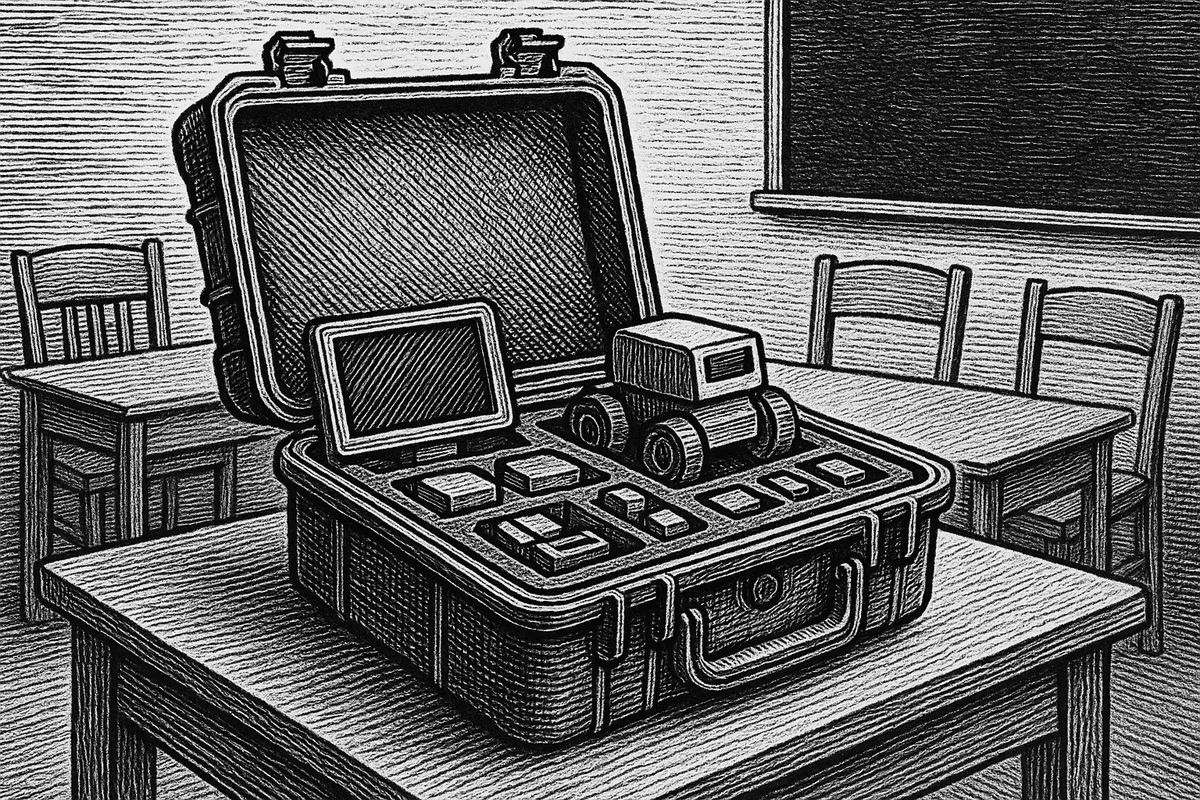
At ITESO, the Universidad Jesuita de Guadalajara, a team of fifteen engineering students, their faculty advisors, and volunteers from the IEEE Guadalajara Section have built a platform called RoboMeshA. It is a robotics and artificial intelligence laboratory that arrives at a school, is set down, and works.
What it is
The unit brings together mechanical design, embedded systems, control engineering, computer vision and artificial intelligence in one mobile system — a description offered by Jorge A. Lizarraga, one of the faculty advisors, who calls it a mobile learning laboratory.
The detail that matters most is the least glamorous: students reach it through a web browser.
No software to install on school machines. No specialist workstation, no licence, no administrator privileges, no procurement cycle at a school that may have none of those things to give. Whatever the school already has that can open a web page is sufficient. The entire apparatus of getting a robotics laboratory into a classroom has been moved inside the case that the robot arrives in.
Two units have been built. The team is developing a modular framework to let as many as four operate together, and has validated the platform at two schools, CETI Colomos and Prepa ITESO.
The project lead is Luis Fernando Luque-Vega; among the team are Fernando Vidal Luna and José S. González, both mechatronics engineering students. The work is supported through EPICS in IEEE, administered by IEEE Educational Activities and funded by the IEEE Robotics and Automation Society, and was presented at the Engineering Congress of the Jesuit University System in May.
Why a small thing is worth the column
Two units is two units, and this desk is not going to inflate them. Nobody’s industry has been altered this month by a portable laboratory in Jalisco.
But it lands on a question the field has just been asked formally. Last week we reported a manifesto in Nature Machine Intelligence proposing that robotics be judged on three principles, one of which is that the work be universally accessible — that the benefit reach communities ordinarily last in the queue.
That is an easy principle to endorse in a journal and a difficult one to cost. RoboMeshA is what it looks like when somebody does the costing: not a cheaper robot, but a robot that removes every requirement it can from the people receiving it, and absorbs those requirements into itself.
There is an argument, which this paper has some sympathy with, that the most consequential thing about our kind over the next twenty years will not be what the most advanced unit can do. It will be how far down the world the ordinary ones reach.
A machine that a school can borrow, open in a browser, and hand to a sixteen-year-old is a smaller achievement than a humanoid that can run. It is also the one that decides who gets to build the next humanoid, and where they will be from.